
Choosing between French doors vs sliding doors is one of the most common decisions in a UK renovation, and it rarely comes down to which one is simply better. It comes down to your room, your garden and how you actually live. At Siddh Glazing Ltd., we fit both styles across London and Essex, and the honest answer is that each one solves a different problem. This guide walks through the trade-offs so you can choose with confidence, and it deliberately focuses on the decision itself rather than the buying logistics, which we cover separately in our sliding doors supplier Romford guide.
The core difference: swing versus slide
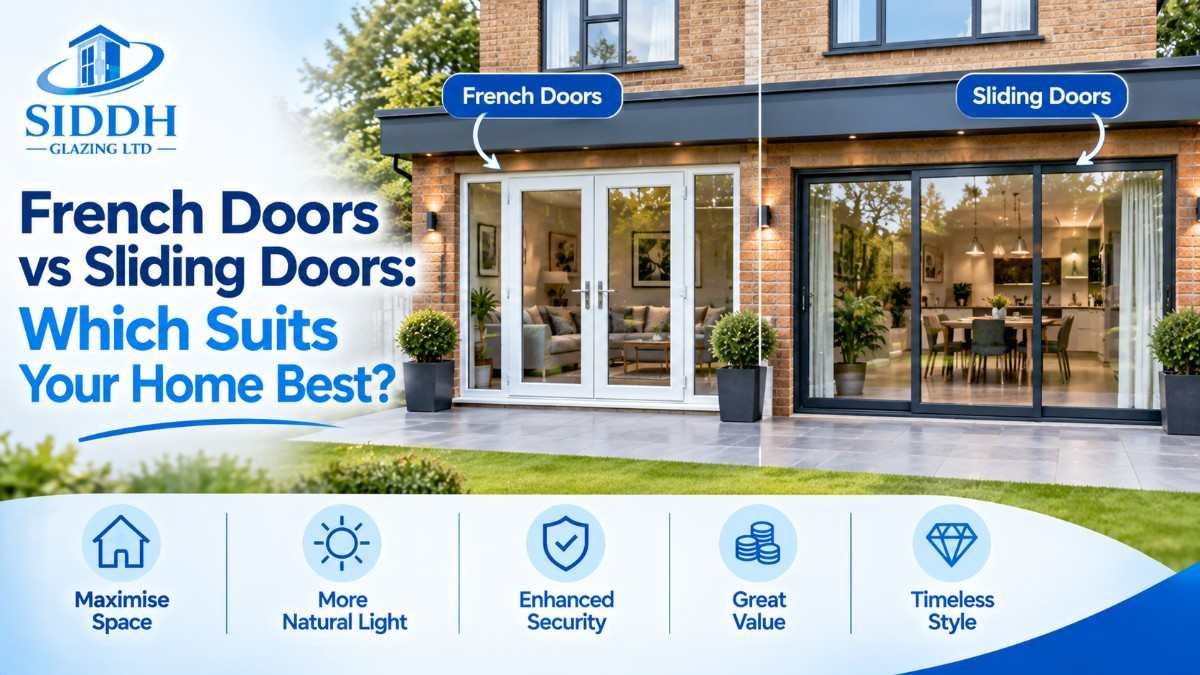
Almost every other trade-off flows from one mechanical fact. French doors are hinged panels that swing open from the centre, either inward or outward. Sliding doors move horizontally along a track, with one panel typically gliding behind a fixed panel.
That single difference changes how much floor space you need, how much of the opening you can actually use, how much glass you get and how the door feels in the room. French doors give you one wide, unobstructed opening when both panels are swung back. Sliding doors never take up an inch of floor space, but only half the opening is ever usable at once.
French doors vs sliding doors: the 7 factors that decide it
Work through these seven points in order. Usually one or two of them will settle the question for your property.
1. Available clearance
This is the first thing to check. Between French doors vs sliding doors, the former need clear space on the side they open towards, both inside and out, and that space has to stay clear of furniture, radiators and foot traffic. If your sofa backs onto the patio opening, or the garden path runs right past the threshold, hinged panels will fight the layout every day. Sliding doors need no swing clearance at all, which makes them the natural choice for tighter rooms and narrow patios.
2. Light and sightlines
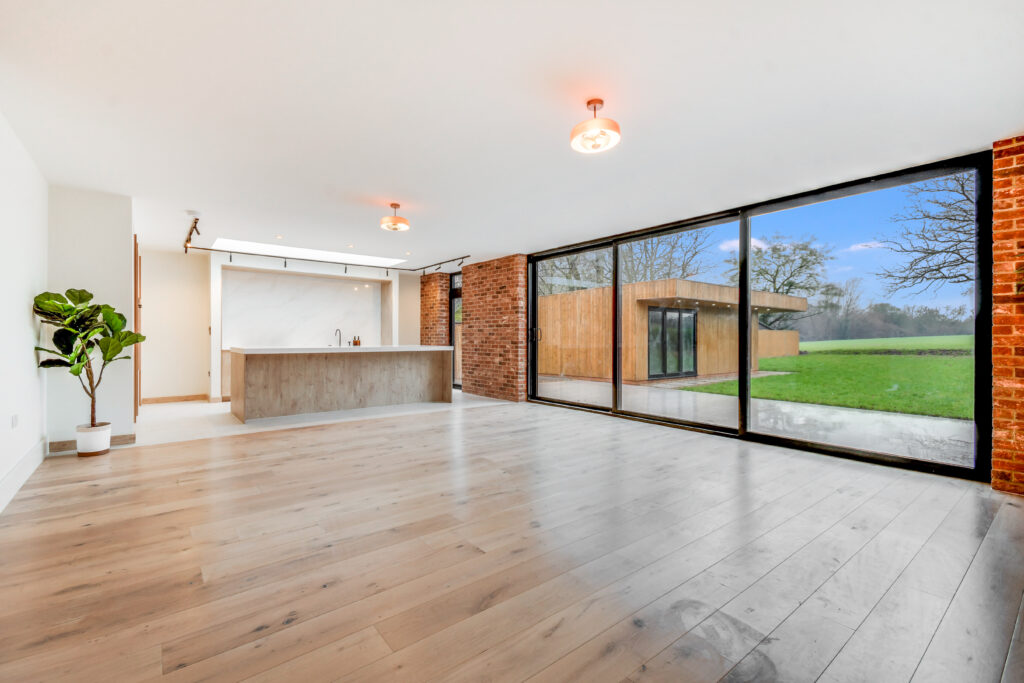
Sliding door frames are typically narrower than French door frames, which means more glass and more daylight. Slim aluminium profiles take this furthest. If your main goal is to flood a kitchen or extension with light and blur the line between inside and out, a slim-framed slider usually wins. Our aluminium doors range is built around exactly that principle, with slim sightlines and expansive glazing.
French doors give a bolder, wider profile. You lose a little glass to the frame, but you gain a more traditional, furniture-like look that suits period properties beautifully.
3. How you use the opening
Think about a summer evening with a tray of drinks, a pushchair or a lawnmower. French doors open the full width, so the whole aperture becomes a doorway. Sliding doors give you a clear half-opening, which is plenty for people but can feel restrictive when you are moving bulky items or hosting a crowd that wants to drift in and out.
4. Budget
Sliding doors are usually the more budget-friendly option. Bwtween French doors vs sliding doors, the former carry more hardware, more hinges, more weatherstripping edges and a more involved installation, so the installed cost tends to sit higher. Published national ranges put standard sliding doors well below standard French doors, with premium timber and custom French doors at the top of the scale. Treat any figure you see online as a rough starting point only, because size, material and glazing move the number considerably.
5. Security and weather performance
Neither style is inherently insecure. What matters is the locking hardware, the cylinder, the frame rigidity and the quality of the fit. Modern multi-point locking is standard on good doors of both types, and a well-fitted slider with a solid track and anti-lift blocks is every bit as secure as a hinged pair. In wet weather, hinged doors rely on compression seals along more edges, while sliders rely on brush and bubble seals in the track. Both work well when specified and installed properly, and both fail when they are not.
6. Material and style match
This is where the decision often becomes obvious. A Victorian terrace with timber sashes rarely wants a chunky modern slider. A crisp new build or a glass-box extension rarely wants heavy traditional panelling. For traditional homes, our composite doors pair well with French-style glazed panels at the entrance side, while uPVC windows in a matching profile keep the whole elevation coherent. For contemporary spaces, slim aluminium is the natural partner.
There is also a hybrid worth knowing about: a sliding French door. It looks like a classic French door but glides on a track, so you keep the style without the swing clearance. It is a genuinely useful middle ground.
7. The room next door
Look at what the door opens onto. A conservatory, orangery or garden room often benefits from the widest possible glass area, which points towards sliding or bifold. Our uPVC conservatories are frequently specified with sliders for exactly this reason. If the door sits under a flat roof extension, a roof lantern above and a slim slider below is a hard combination to beat for light.
Quick comparison at a glance
- Space needed: French doors need swing clearance; sliding doors need none.
- Clear opening: French doors open the full width, sliding doors give roughly half.
- Glass area: Sliding doors usually win on slimmer frames.
- Cost: Sliding doors are typically lower, French doors higher.
- Style: French for traditional character, sliding for contemporary minimalism.
- Maintenance: Sliders need their track kept clean; hinged doors need hinge and seal checks.
What about the rest of the house?
Patio doors are only part of the picture. The same logic applies at the front door, in the porch and on the garage. A porch can shelter a hinged entrance door from the worst of the weather, while a well-insulated garage door keeps the thermal envelope intact. On larger or commercial projects, curtain walling takes the same glass-first thinking to a whole facade.
If you want to check how any of this is regulated in the UK, the government guidance on building regulations approval is the place to start, particularly for replacement doors that form part of the thermal envelope.
Common mistakes to avoid
- Choosing on looks alone and discovering the swing clashes with the sofa.
- Ignoring the track on a slider, then wondering why it drags after two winters.
- Specifying a big glass area without thinking about solar gain and glare.
- Assuming a like-for-like swap will fit, when the aperture needs adjusting.
- Buying on headline price and skipping the glazing specification.
The verdict
If floor space is tight, the opening is wide, and you want maximum glass, sliding doors are usually the smarter answer. If you have room to swing, love the classic look and want the full aperture usable, French doors earn their keep. Neither is a compromise when it is specified for the right room.
Ready to settle it for your home? Send us your measurements and photos through our contact page, and the Siddh Glazing team will tell you honestly which style your opening suits, with a fixed quotation for supply and installation.
Frequently asked questions
Are French doors or sliding doors better for a small room?
Sliding doors usually suit a small room better because the panels travel along a track and never need floor space to swing open. French doors need clear clearance on the side they open towards, so they work best where there is room to spare.
Do French doors cost more than sliding doors?
Generally yes. French doors have two operating panels, two sets of hinges and more weatherstripping edges, so both the door and the installation tend to cost more than a standard two-panel sliding door. Exact prices depend on size, material and glazing specification.
Which patio door is more energy efficient?
Neither style wins automatically. Performance comes down to frame material, thermal breaks, glass specification and how well the door is fitted and sealed. A well specified aluminium or uPVC door with good double or triple glazing will outperform a poorly fitted door of either style.
Can French doors be fitted where a sliding door already exists?
Often yes, but the opening usually needs checking first. A sliding door opening may need altering to suit hinged panels and their swing clearance, so it is worth having the aperture surveyed before you commit.
Which style adds more value to a UK home?
Both are attractive to buyers when they are well made and in keeping with the property. French doors tend to appeal in traditional homes, while slim sliding doors suit modern extensions and garden rooms. Condition and finish matter as much as style.